As research on pasture-based dairying grows, JDS Communications® seeks to define these systems more clearly and identify where the science needs to go next
Philadelphia, October 14, 2026 – Research on pasture-based dairy systems has seen a steady increase in the past 30 years, driven by consumer interest in grass-fed dairy products, closer attention to cow welfare, and a sector-wide push to make dairying more efficient and sustainable. A special issue of JDS Communications, “Pasture-Based Dairy Production Systems,” takes up a question that has accompanied this growth: what exactly defines a pasture-based system, and, in defining it, can we better understand what pathways exist to improve it for the future?
John Roche, PhD, guest editor of the special issue, chief science advisor to New Zealand Prime Minister Christopher Luxon, and deputy chair of the Prime Minister’s Science and Technology Advisory Council, explains, “As an editor, reader, and conference attendee, I regularly see ‘pasture-based’ applied to both intensively managed grazed pasture operations and systems in which grazing is present but not central to production. Both systems are valuable, but getting specific about defining and measuring each in terms of nutrition, genetics, welfare, milk composition, and environmental performance helps us improve both.”
From the outset, Roche and the authors featured in the special issue define a pasture-based system by the primacy of grazed pasture in the cow’s diet: pasture is her dominant feed source and her primary environment. Working from that shared definition, the broad collection of articles covers dairy foods—including a review of the compositional differences in milk from pasture-based cows—and dairy production, ranging from animal nutrition to genetics, health and welfare, and physiology.
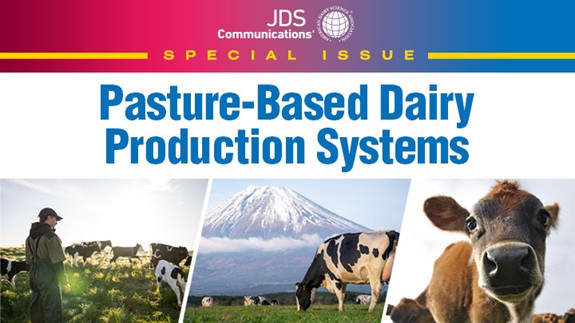
Caption: In a new special issue, JDS Communications takes a comprehensive look at what defines pasture-based dairy systems and the unique questions we’re focused on for their future (Credit: iStock.com/Don Wu, iStock.com/Puwaphat Petchpuwadee, iStock.com/Lakeview_Images)
A mini-review led by Daniel J. Donaghy of Massey University in New Zealand and an international team of coauthors proposes that more is not always better when it comes to forage selection. The article examines how strategic selection of forage plants shapes what a temperate system can achieve, and offers a pragmatic framework to help define clear objectives, assess site constraints, and strategically select a modest combination of complementary forage species tailored to a specific environment and management capacity.
When well-managed, this resulting pasture provides nearly all the nutrients a moderate-yielding dairy cow needs with minimal supplementation, argue Roche and his coauthors in a review examining the unique features of these systems for animal nutrition. Managing dairy cows on pasture, they outline, requires balancing three unique factors: the perishable nature of fresh grass, the priority of metabolizable energy as the primary nutritional limit for pasture-based dairy cows, and the substitution effect, where supplementation can be beneficial during periods of low pasture growth, but it can also reduce pasture intake and overall farm profitability.
The economics of diet supplementation for pasture cows is then taken up by Christie Ho of Agriculture Victoria in Australia and colleagues, who evaluated what happens when supplements are tailored to each cow’s unique higher or lower nutritional requirements versus a flat rate—finding that the slightly higher profitability that results isn’t quite significant enough to warrant leaving behind the simpler approach of flat-rate supplementation.
Pasture-based dairy systems also come with distinct management and labor demands, as farmers move cows regularly to manage grazing and make the most of available pasture. In an article by Callum R. Eastwood of DairyNZ in New Zealand and colleagues, the team interviewed farmers to understand their experiences with a potentially transformative new technology in virtual fencing—an emerging wearable device and system that either “fences” or herds animals through a combination of sound, vibration, and pulses. They found that, despite remaining hurdles in cost and implementation, it has the potential to improve work-life balance on farms and reduce stress while reducing labor requirements and boosting flexible grazing.
Managing cows on pasture also impacts the surrounding environment, as dairy cows produce nutrients like nitrogen and phosphorus from urine and dung, which have the potential to run off into surrounding freshwater. In an article, Richard McDowell of Lincoln University in New Zealand and coauthors outline the latest science in mitigating these nutrient losses through targeted and cost-effective solutions like nutrient budgeting, strategic grazing, and edge-of-field interventions such as planting trees and other native plants, setting up retention ponds, or beds of woodchips to provide alternative lines of defense.
Can we breed future cows that are uniquely suited to the pasture-based dairy farm? Donagh Berry of Teagasc’s Animal & Grassland Research and Innovation Centre in Ireland and an international author team argue that the answer is yes. They present a short communication on genetically selecting cows that use nitrogen more efficiently and expel less of it. Measuring nitrogen utilization in dairy cows is extremely challenging, but mid-infrared milk spectroscopy—a technique that measures the concentration of components in milk samples—offers a reliable method for selecting for nitrogen traits.
Taken together, the 41 papers in the new issue treat pasture-based dairying as an integrated and unique biological, economic, environmental, and social system deserving of dedicated study and tailored approaches to its research and management. “These are not low-management or low-tech systems; they are dynamic for producers and cows alike,” explained Roche, “requiring the ability to handle seasonal shifts of climate, species composition, soil fertility, and grazing management, while cows must harvest their own feed, stay healthy, get back in calf, and produce milk in an environment prone to change.”
“JDS Communications publishes for a global dairy science community, and the questions in this issue are being worked on simultaneously in Ireland, the United Kingdom, France, New Zealand, Australia, South America, and elsewhere,” said Jessica A. A. McArt, DVM, PhD, DABVP (Dairy Practice), editor in chief of the journal. “A system this widely practiced deserves to be described on its own terms, and the definition this issue outlines can help us create real comparison, whole-system accounting, and make shared progress easier for these critical systems in the global dairy industry.”
Notes for editors
All of the special issue articles are openly available in JDS Communications, volume 7, supplement 1 (August 2026), published by the American Dairy Science Association and Elsevier.
Full text of each article is also available to credentialed journalists upon request; contact Eileen Leahy at +1 732 406 1313 or jdsmedia@elsevier.com.
Journalists wishing to interview the authors should contact the American Dairy Science Association at adsa@adsa.org.
About JDS Communications
JDS Communications®, an official journal of the American Dairy Science Association®, is co-published by Elsevier and ADSA. The journal publishes narrowly focused, original research studies designed to answer a specific question on the production or processing of milk or milk products intended for human consumption. In addition to short research articles, JDS Communications publishes mini reviews—unsolicited, concise review papers. Research published in this journal is broadly divided into the production of milk from food animals (nutrition, physiology, health, genetics, and management) and processing of milk for human consumption (dairy foods). JDS Communications aims for rapid turnaround and a short time to publication. www.jdscommun.org
About the American Dairy Science Association (ADSA®)
The American Dairy Science Association (ADSA) is an international organization of educators, scientists, and industry representatives who are committed to advancing the dairy industry and keenly aware of the vital role the dairy sciences play in fulfilling the economic, nutritive, and health requirements of the world’s population. It provides leadership in scientific and technical support to sustain and grow the global dairy industry through generation, dissemination, and exchange of information and services. Together, ADSA members have discovered new methods and technologies that have revolutionized the dairy industry.www.adsa.org
About Elsevier
Elsevier is a global leader in advanced information and decision support. For over a century, we have been helping advance science and healthcare to advance human progress. We support academic and corporate research communities, doctors, nurses, future healthcare professionals and educators across 170 countries in their vital work. We do this by delivering mission-critical insights and innovative solutions that combine trusted, evidence-based scientific and medical content with cutting-edge AI technologies to help impact makers achieve better outcomes. We champion inclusion and sustainability by embedding these values into our products and culture, working with the communities that we serve. The Elsevier Foundation supports research and health partnerships around the world.
Elsevier is part of RELX, a global provider of information-based analytics and decision tools for professional and business customers. For more information, visit www.elsevier.com and follow us on social media @ElsevierConnect.