A global team of experts synthesizes decades of science on biofilms in dairy and offers a roadmap for future research from an integrated “One Biofilm” perspective
Philadelphia, November 25, 2025—The Journal of Dairy Science has released a special issue dedicated to one of the most pressing challenges in dairy: biofilm formation. These microbial communities, which stick to surfaces at both the farm and factory, can contaminate milk, cause udder infections in cows, and compromise the quality and safety of dairy products. The special issue, Biofilm Formation in Dairy: A Food Safety Concern, brings together leading international experts to outline a holistic “One Biofilm” perspective. Similar to the “One Health” approach—which links human, animal, and environmental health—this new collection of articles highlights that abating biofilms requires an integrated strategy that connects farms, processing plants, and the environment.
In their introduction to the special issue, the issue’s co-editors, Denis Roy, PhD (Université Laval, QC, Canada), and Mérilie Gagnon, PhD (Op+Lait and Centre ACER, QC, Canada), explained that a bacterial biofilm is a community of cells that form a protective colony resistant to cleaning agents, disinfectants, antibiotics, and immune system response. “Biofilms are difficult to see, but their impact on dairy safety and quality can be enormous,” said Roy. “By gathering the latest research in one collection, we hope to help farmers, processors, researchers, and consumers have a resource to understand all of the latest research on biofilms in dairy environments from this ‘One Biofilm’ perspective—including how they form and how they’re structured, their composition in milking machines, impacts on milk quality, and our best methods for analyzing them—along with the exciting new antibiofilm strategies that are emerging to combat them.”
The special issue opens with a comprehensive literature review of 45 microbial-community tracking studies, revealing that the majority of the research to date has focused on a single focal point for studying biofilms. Only a few studies have been conducted on tracking, profiling, and monitoring biofilms across the dairy supply chain from farm to processing. This limited scope hinders our ability to manage biofilms effectively, the team states. “By comprehensively mapping how these communities assemble, we can better identify points of intervention to improve both food safety and product quality,” said Gagnon. “We now know that future primary research on understanding the structure of biofilms is needed to better understand the on-farm practices affecting their development later on in milking systems,” explained Gagnon.
In this spirit, the next review article in the special issue focuses on the farm, explaining that the milking machine creates ideal conditions for microbial communities to form and then detach, contaminating bulk milk and creating potential food safety risks. The review reveals that—although we do understand how these biofilms form in the milking machine—less is known about how they detach. The research emphasizes that effective management requires a multipronged approach, combining hygienic equipment design, optimized cleaning protocols, and proper farm management. It also introduces the PiloTraite, a pilot-scale milking simulator, as a crucial tool for bridging the gap between lab research and real-world farm conditions. The review concludes that future efforts should focus on understanding the complete lifecycle of biofilms, especially their detachment, to ensure hygienic milking systems and safe dairy production.
The biofilm impacts from milking equipment on the bulk milk tank were the focus of the subsequent article. The research team examined the bulk milk tank—and the entire milking system of a dairy farm—for the presence of Pseudomonadota, which is a common biofilm-forming bacterium found in raw milk. To overcome the limitations of existing methods, the researchers developed a new culture medium, S1 milk agar, which effectively isolated these microorganisms. “Even after recommended cleaning procedures, they found viable microorganisms attached to milking equipment,” Gagnon noted. “This underlines the need for us to develop new and improved sanitation practices, especially when groups such as Pseudomonadota dominate biofilm formation.”
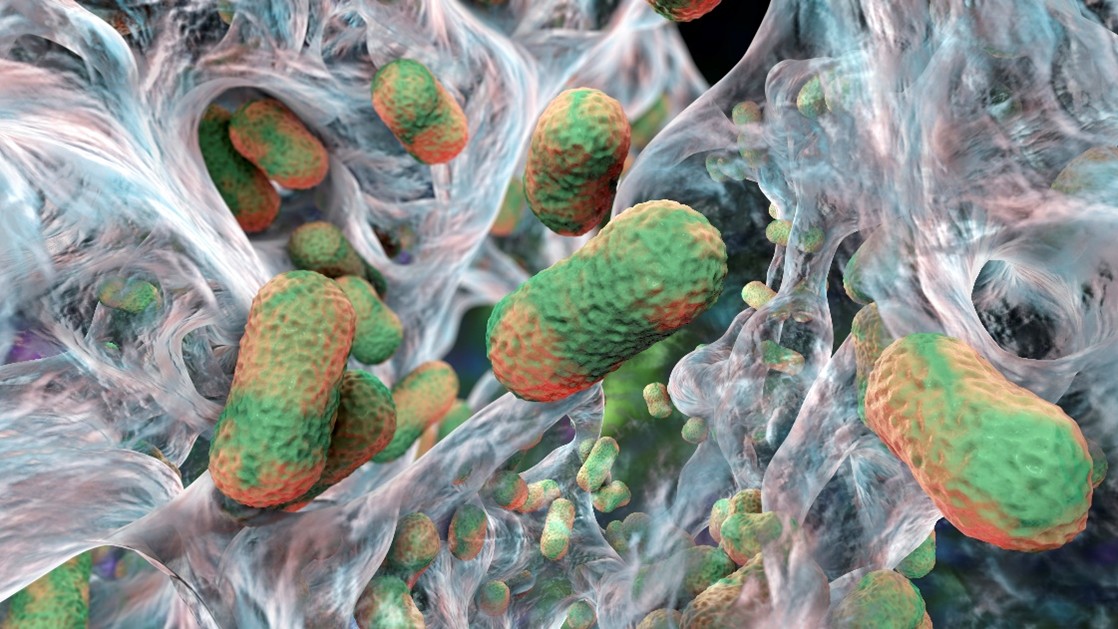
Caption: A global team synthesizes decades of microbiological research to help the dairy industry better understand and manage biofilms across every stage of dairy production (Credit: iStock.com/Dr_Microbe).
What existing and emerging tools exist to control and combat these biofilms? That is the focus of the next review article in the special issue, along with the persistent challenges posed by biofilm-forming bacteria throughout the dairy industry from the farm to the processing plant. The review explores a range of innovative strategies to combat these biofilms, with a particular focus on effective, nature-based approaches that take into account the environment, animal health and welfare, and human health. These promising mitigation methods include inhibiting bacteria from sticking to surfaces, disrupting their ability to mature through quorum sensing (a form of bacterial communication), and deploying antimicrobial peptides and hydrolytic enzymes. The research also emphasizes the effectiveness of natural compounds such as plant-based essential oils, bee products like honey, and marine products such as chitosan. By using these sustainable and environmentally friendly strategies, the dairy industry can better protect biodiversity, reduce the use of harsh chemicals, and improve both human and animal health.
The clinical implications of biofilms were examined by the final review article, which explores how different genetic strains of Staphylococcus aureus—one of the leading causes of bovine mastitis in dairy cows—form biofilms that enable them to resist antibiotic treatment. Research shows that while most strains were susceptible to antibiotics in their free-floating state, those that were able to better produce a biofilm colony were much more tolerant to treatment. This suggests that identifying the specific genetic makeup of a mastitis-causing Staphylococcus aureus strain could help predict the effectiveness of antimicrobial therapy, allowing for more targeted and successful treatment of dairy herds.
Collectively, the issue highlights the progress research has made in understanding and combating biofilms in dairy and the remaining hurdles to clear to help inform dairy professionals and consumers, as well as provide a helpful roadmap for biofilm researchers. “This special issue represents the collaborative spirit of dairy science,” said Paul Kononoff, PhD, editor in chief of the Journal of Dairy Science. “The research presented here advances our understanding of biofilms from farm to processing, and points toward practical solutions that protect both product integrity, the bottom line for dairy producers, and our shared public health.”
Notes for editors
All of the special issue articles are openly available in the Journal of Dairy Science, volume 108, issue 8 (August 2025), published by the American Dairy Science Association and Elsevier.
Full text of each article is also available to credentialed journalists upon request; contact Eileen Leahy at +1 732 406 1313 or jdsmedia@elsevier.com. Journalists wishing to interview the authors should contact Denis Roy, PhD, at denis.roy@fsaa.ulaval.ca and Mérilie Gagnon, PhD, at meriliegagnon@centreacer.qc.ca.
About the Journal of Dairy Science
The Journal of Dairy Science® (JDS), an official journal of the American Dairy Science Association® (ADSA), is co-published by Elsevier and ADSA. It is the leading general dairy research journal in the world. JDS readers represent education, industry, and government agencies in more than 70 countries, with interests in biochemistry, breeding, economics, engineering, environment, food science, genetics, microbiology, nutrition, pathology, physiology, processing, public health, quality assurance, and sanitation. JDS has a 2024 Journal Impact Factor of 4.4 and five-year Journal Impact Factor of 4.4 according to Journal Citation Reports™ (Source: Clarivate™ 2025). www.journalofdairyscience.org
About the American Dairy Science Association (ADSA®)
The American Dairy Science Association (ADSA) is an international organization of educators, scientists, and industry representatives who are committed to advancing the dairy industry and keenly aware of the vital role the dairy sciences play in fulfilling the economic, nutritive, and health requirements of the world’s population. It provides leadership in scientific and technical support to sustain and grow the global dairy industry through generation, dissemination, and exchange of information and services. Together, ADSA members have discovered new methods and technologies that have revolutionized the dairy industry. www.adsa.org
About Elsevier
Elsevier is a global leader in advanced information and decision support. For over a century, we have been helping advance science and healthcare to advance human progress. We support academic and corporate research communities, doctors, nurses, future healthcare professionals and educators across 170 countries in their vital work. We do this by delivering mission-critical insights and innovative solutions that combine trusted, evidence-based scientific and medical content with cutting-edge AI technologies to help impact makers achieve better outcomes. We champion inclusion and sustainability by embedding these values into our products and culture, working with the communities that we serve. The Elsevier Foundation supports research and health partnerships around the world.
Elsevier is part of RELX, a global provider of information-based analytics and decision tools for professional and business customers. For more information, visit www.elsevier.com and follow us on social media @ElsevierConnect.