Today’s trailblazing dairy science innovations are built on the incredible work being done by a diverse, interconnected, global scientific community. Get to know a fellow community member in our ongoing spotlight series—now featuring the talented editors of JDS Communications.
Robin White, PhD, is the JDS Communications Animal Nutrition and Farm Systems section editor and a professor of ruminant nutrition and sustainable agriculture at Virginia Tech. Her team focuses on improving the understanding of ruminant nutrition and leveraging nutrition and technology to enhance sustainability and efficiency. We caught up with her to discuss her latest research, get her thoughts on the best kind of critical feedback from colleagues, and discover her tips for embracing scientific publishing as a communication tool.
What drew you to the ADSA community and to working on the journal team?
One of my first papers was a Journal of Dairy Science paper, and it wasn’t a great paper—it took something like four rounds of review to get it through the process. I learned a lot from that review process, and the paper ended up in a better place than it started. As a postdoctoral researcher with the National Animal Nutrition Program, I got to do a lot of work relevant to the ASDA community, and I was really impressed by the quality of nutrition science and modeling. The high standards of this community and the continued effort to improve on our state of science are ultimately what made me interested in working on the journal team. I remain interested, after several years of service, by the fascinating questions and opportunities posed by the rapidly changing state of science and how science is communicated in the age of artificial intelligence technologies.
When not working on the journal, what specific questions or challenges within the field of dairy science are you currently working on?
Our lab works across levels of biological organization, seeking to produce solutions to support the sustainability of the ruminant livestock industries. We have a couple of interesting projects that are worth highlighting right now. One is a bit of a pie-in-the-sky project, exploring the degree to which we can leverage physiological sensing to inform the precision feeding of dairy cattle, and how that precision feeding can support environmental and economic production objectives. The sensing component seeks to automate the monitoring of volatile fatty acid profiles produced during fermentation, along with the fluid dynamics within the rumen. The precision feeding component explores how multiobjective optimization can be leveraged to support diet design intended to enhance productivity and limit environmental impacts. This work, funded by the USDA, is intended to reimagine how we might formulate dairy rations (several decades from now). It may result in interesting shifts in our approach to ration formulation, or may help us define one more way not to design rations.
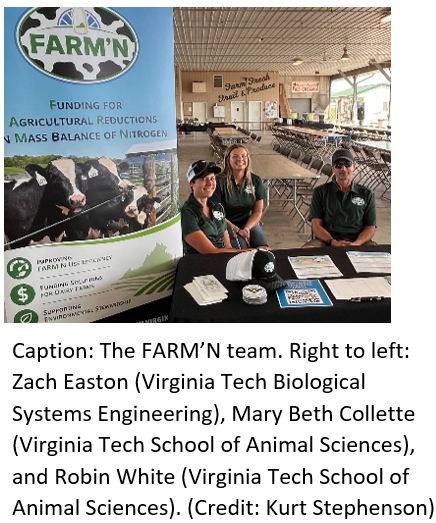
Our lab is also a partner on an interesting project here in Virginia that brings together the Virginia State Dairymen’s Association and Virginia Tech’s Biological Systems Engineering Department, Agricultural and Applied Economics Department, School of Plant and Environmental Sciences, and School of Animal Sciences. The project (named FARM’N: funding for agricultural reductions in mass balance of nitrogen) pays dairy producers in Virginia to improve their whole-farm nitrogen-use efficiency. We work with farms to establish a baseline nitrogen-use efficiency based on three years of production records, and monitor annual nitrogen-use efficiency changes from that baseline. This work supports the state’s water quality and environmental conservation objectives, and is funded by the Virginia Department of Environmental Quality and Amazon Corporation. This work is immediately translating science into practice by providing risk abatement and economic incentives for producers to explore strategies and technologies that may help improve their nitrogen-use efficiency based on the strengths and areas of opportunity on their unique farms.
Together, these represent the scope of projects we undertake, which include diverse levels of, and approaches to, inquiry.
Scientific publishing plays a crucial role in the field of dairy science. What’s the number-one thing you would tell prospective authors to help them in their publishing work?
Honestly, I don’t think I’m the person to answer this question! I feel a lot of conflicting things about the peer-review process. The quality of reviews is declining; it is extremely challenging to find good reviewers and to not overburden those individuals who participate in the peer-review process. At the same time, we have submission numbers increasing every year, and it feels like the system is failing the stress test. That said, science communication is critical. Maybe the peer-review system won’t (and shouldn’t) look like this forever, but we do need participation in the process, and we do need a means of translating science to scientific and general audiences. I think the dairy science community has always been very forward-looking, and I am excited to see how the community navigates the upcoming challenges related to these pressures on the peer-review system, along with the issues and opportunities presented by emerging technologies like large language models and generative artificial intelligence. Is that advice for authors? No, but I will beg them to engage meaningfully in the process, to view papers as communication tools that are vital to extending the impact of their work, and to be willing to engage with and be interested in exploring how emerging technologies can be leveraged to support science communication without compromising the quality and integrity of the scientific review process.
Feedback from editors and reviewers can be hugely impactful in the publishing process and in an author’s overall career. In your own publishing work, do you have a comment from an editor or reviewer that was especially helpful for you? If you’d like to share, do you have an unhelpful comment that has stuck with you in your role as an editor?
What isn’t helpful:
- Asking the authors to do the experiment you wanted them to write instead of the experiment they actually did. Review the work that is presented, not what could have been.
- Missing the forest through the trees—often, reviewers focus only on small, nitpicky grammatical issues and fail to provide meaningful commentary about the broader approach to the paper, experiment, and so on. Focusing on the soundness of the science is most important in a review.
What is helpful:
- Some of the best feedback I’ve gotten hasn’t necessarily been from reviewers, but often comes from coauthors who are exceptional scientists. Practical reminders like “well that’s great, Robin, but we still feed with a skid loader,” are the type of feedback that stick with me. In that case, Dr. Bill Weiss was pointing out that my model with high precision and accuracy may have no relevance in the real world because I was implying a degree of precision that can’t be reliably achieved on farm. Embracing the perspective of individuals with expertise different from my own has been critical in making my own work better.
In your experience, what aspects of dairy science are the most fascinating or enjoyable? Conversely, are there specific challenges within the field that you run into, or wish there were better solutions available for?
One thing that has been really enjoyable about our FARM’N project is to observe the degree to which farms are already adopting the most recent research, as well as their eagerness to translate science into their operations as rapidly as is feasible. Dairy producers are an incredible, resilient, and ingenious bunch, and I consider it a great honor to conduct science for their benefit.
Similarly, on our current USDA project, I never cease to be amazed by the physiological gymnastics performed by the high-producing dairy cow. This animal is among the most fascinating nutritional subjects a scientist can work on. When presented with a rich and intellectually stimulating research subject that is also coupled with an interested and deserving research audience. . . . I can’t imagine a better subject matter for study.
We know authors have many options for which journals they submit to. What benefits do you see to publishing in a society journal, such as JDS Communications?
Honestly, I think we need to do a better job of differentiating this for authors. Adapt or die: In a recent reader and author survey, the JDS/JDSC reputation stands out as a reason why authors select these journals. However, reputation is challenging to quantify and challenging to advertise. As we continue to navigate the science communication quagmire, it will be increasingly important to ensure we have a value story that can be clearly communicated with tangible metrics.
Strengthening our shared dairy science community means celebrating more than just our professional selves. Outside of work, what activities or hobbies bring you joy?
I’m an active equestrian, participating in eventing, dressage, and the jumpers with my young horses. I also enjoy trail running, mountain biking, and hiking. My husband and I are the proud owners of a forested mountain property outside of Blacksburg that serves as our project sandbox, allowing great opportunities to learn fun practical skills like heavy equipment operation, road construction, timber harvesting, sawmilling, timber framing, water and solar systems engineering, internal combustion engine to electric vehicle conversions, and trail building, among others.